Just a heads up that this is a very personal post, with limited relevance to investing. Proceed at your own risk.
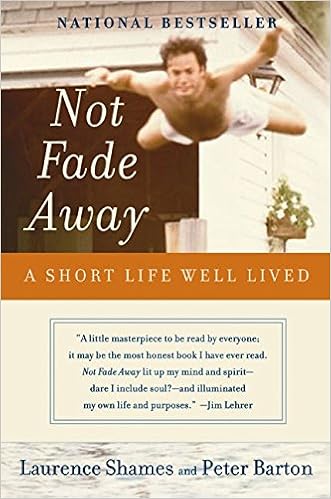
This book has to be one of the most moving ones I read in a while and thought it was worth writing a review with some of my personal reflections as well. The recommendation originally comes from Tim Ferriss'
interview on his podcast with Chris Sacca. Chris is a VC but has taken a different approach to the traditional way of doing things and his
portfolio includes a number of companies that turned out to be unicorns (his interview and story are worth checking out).

Back to the book. The story is about Peter Barton whom along with John Malone completely changed the cable industry. Peter was part of the baby boom generation and accredits his growing up in this era, where kids weren't pressured to become astrophysicists at age 5, to much of his success in life. He has been an all around bon vivant, musician, self-described ski-bum, Columbia University student, political campaign strategist, working in politics and eventually going to work for John Malone as his right-hand man turning the cable industry inside out and retiring in 1997 at the age of 46 to spend time with his family. Except life had other plans...he passed away in 2002.
He was diagnosed with stomach cancer, which after a while seemed to have been cured, however it unfortunately came back in a terminal version one year later. During the last period of his life Peter got together with writer
Laurence Shames to put all of his life and experiences on paper, which resulted in this gem of a book. At first he was reluctant to get involved in this project:
"I tried my damnedest not to get involved in the writing of this book, or with a man named Peter Barton, whose life it celebrates and whose death it chronicles. My reason for resisting was simple: My own small existence was on a very pleasant, even keel; I didn't want to disrupt it by getting close a dying stranger. I didn't want to think about mortality, still less watch death happening from day to day. I didn't want to grow to care about a family that would soon be fatherless". Fortunately for the readers he did get close and wrote this wonderful book.
Instead of going through the whole book I thought to take out a few parts and lessons that stuck with me the most as I was reading it. You can read about Peter Barton's life in his
obituary.
"Funeral Test" (i.e. whoever has the biggest funeral wins): "The official recognition [of Peter's achievements] was impressive...and yet it seemed oddly impersonal, beside the point. Peter would have been more pleased, I think, to see the hundreds of friends who rallied around his family. Kids he'd coached, or taken along on his Real World Outings. Colleagues he'd advised and schemed with. Neighbors whose dogs had gotten muddy alongside Peter's dogs. People he'd skied with, or biked with, or with whom he'd sat around the piano and jammed and wailed. More than fifteen hundred of these friends and colleagues and acquaintances turned out for Peter's memorial - an event intended not for mourning but for celebration. There was a gospel choir, and a children's choir in which Kate [his daughter] sang. There was food and wine. There was a stitched together video of Peter's life, accompanied - of course! - by a rock'n'roll soundtrack. And there were speeches. In keeping with the spirit of the evening, the speakers passed lightly over the subject of Peter sick and dying, still seeking meaning in the face of pain and honest doubt. Instead, they spoke of Peter in his glory. Peter, who believed that nothing was impossible. Peter, who could step into a situation, overwhelmed but never daunted, and master it. Peter who skied too fast, drove too fast, worked too hard, and made it all look easy."
Finding the right spouse: "Relationships had been one of those aspects of life in which I made things harder for myself, was too feisty for my own good. I'd waffled on commitment. I'd sometimes been unkind by simple inattention, being too wrapped up in other things. I don't think I'd ever truly let someone into my life. I was also saddled with the odd and macho notion that a man needed different sorts of woman at different ages. [...] What I was too dumb to realize, of course, was that if you were lucky enough to meet the right woman, she was all of those things and more - and the two of you evolved together. When I met Laura [his wife] I finally started to understand that. And thank God I did. [...] Previously, if there were difficulties, rough patches in relationships, I walked. Now we worked things out. Previously, I did things my own way, by reflex. Now I was willing to pause, to see the wisdom in Laura's way. It was crucially important to me to get this right, because I had the absolute conviction that if Laura and I started a family, we would stay together forever."
It's not all about the money: "It was a messy beginning, but CVN really took of. Within two years it was a billion-dollar business with forty-six hundred employees. But I'm a start-up guy by temperament, and by then I was tired of running it. The only way to make a graceful exit was to merge the company with another recent start-up called QVC. At this point I could finally sit still long enough to consider my stock options. I saw what they were worth - three million bucks, a million and a half after taxes! - and cashed them in at once. Now, some people might say that a million and a half dollars is not a lot of dough, but to me it was that most elusive amount: enough. Enough so that I was confident my wife and kids would be secure. Enough so that everyone would have a home and tuitions would be paid. Enough so that if I dropped dead tomorrow, everyone would be okay. I was over the hump. I could do right as a father. I was thirty-eight when that money came to me. More money has come as money does; it takes on a momentum of its own. But the rest has been Monopoly dough, just a way of keeping score."
Teaching kids about the world beyond school: "Just as it's crucial for underprivileged kids to be shown that there are possibilities beyond their neighbourhoods, it's also important for overprivileged kids to see other sides of life. I didn't want my kids to grow up in an abstract world of deals and numbers and money that just happened. I wanted them to understand that people worked hard, at a gloriously wide range of things, and that there was dignity in all of them. So I bought a big stretch van - my rolling locker room - and started taking my kids and their friends on what I thought of as Real World Outings. They were like school field trips, but without the onus of school. I was never "Mr. Barton". I was always Peter. [...] Every outing had a theme. "Grease" - where we looked at the realities of fast food. "Garbage" - where we followed the trail of household trash, and of recycled cars and asphalt and concrete. [...] Sometimes, at the end of our outings, there'd be the strangest sound in the van: silence. How rare was that? Ten or twelve kids, thinking something over."
Oh and a practical one about job applications: [after finishing his MBA] "As a matter of personal preference and quality of life, I would only work in Boston, San Francisco, or Denver. Well, with all those conditions I was clearly limiting my options. But I did my homework, and I came up with a list of possible employers. I started with a personal Who's Who of 231 names and sent each of them a letter [offering to work for free for a period]. Amazingly, 123 CEOs responded. For various reasons, that group was gradually whittled down to three possibilities in Denver. There was a hippy tea company and two-cable television outfits. The tea people didn't really want me, and of the cable companies was already top-heavy with MBAs. That left a dinky little outfit called TCI, which was headed by a seat-of-the-pants, feet-on-the-desk visionary named John Malone. From our very first conversation I realized that Malone was the guy I wanted to work for. He thought huge. He was informal, original, and totally audacious."
And one last quote in closing:
"If I have anything at all to teach about life, it probably comes down to these two simple but far-reaching notions: Recognizing the difference between a dumb risk and a smart one, and understanding when you need to change direction, and have the guts to do it."
My Story
I'm always fascinated with the next chapter after our lives and books like these or
Bronnie Ware's actually help reduce the fear, at least for me. Don't get me wrong it's not something I'm seeking out actively but there was a period in my life when I had to face it, very fortunately my story turned out better than Peter's.
Let me explain. Many years ago I was diagnosed with an advanced stage cancer, fortunately however it was entirely treatable. I still remember learning about it at first. I was in my car and everything around me has seemed to have slowed down with an odd sense of quietness that to this day I cannot describe. At first you go through phases of denial (i.e. I'm way too healthy, way too young, and so on) and then you realise that there are no ways around it, only through it. Over the next few weeks I've read everything I could get my hands on about what this is, what's involved in terms of the treatment, side effects but nothing can prepare you for the shock that you are going to experience.
The physical pain and side effects are one thing, however what's tougher is dealing with your own psychology. I'll spare you all the horrors about the first part, however the second is worth exploring a bit. I've realised that it's not until you accept that you have this illness you can face it head on, and the earlier you accept the better. Once your mind is fully on board you've conquered yourself and your fear, which is half the battle as they say. I mean it. I've experimented with different approaches to going through treatment days but what always worked is going to the hospital in the right state of mind (i.e. that this can be cured and I'll do my best to do it). This was a game changer. At the very beginning there were days when I just couldn't bring myself to be fully functional and that was trouble. A standard one day treatment would take two days, there would be complications, pain and so on, so these experiences served as a good guidepost that no matter what you just cannot give up. Perhaps the saddest part that I had to experience and see first hand is children and the elderly having to go through this pain and sometimes having the worst outcome. It's just simply unfair and terrible to see the vulnerable go through this but you've to block these events out otherwise they'll overwhelm your mind.
I'd share one short story from that year. I came to the very end of the treatment, however unfortunately I wasn't yet fully cured. This was hugely negative as I was completely exhausted by the end. The doctors (to whom I'm eternally grateful) suggested more and stronger treatment, but as they say doing the same thing over and over again and expecting different results is insanity. I thanked them for their help and guidance but politely declined and took three peaceful months off from everything. I went with my gut and experienced a strange sense of calmness. At the end of the third month a regular check-up showed that I was fully healed. Cancer treatment puts a huge amount of stress on your body (it's why people lose their hair for instance) and somewhere deep down I knew that ultimately doing more of the same wasn't the right answer. I would have only gotten weaker or who knows what would have happened. The downside to this three month break would have been a few months delay in this treatment if things didn't turn out for the better. Sometimes your gut already knows what's best for you, you just have to listen to it. Since then I'm watching my health like a hawk, sometimes driving doctors crazy.
Extreme events in life have a tendency to reduce the fear we experience and it is no different for me. Your worst case scenario (i.e. what's the worst that can happen if I do ABC) shifts drastically. Interestingly it didn't make me believe that I'm infallible, but more rational I'd say and grateful for all the opportunities I got since. Life just snowballs for the better once you let go.
I've been thinking throughout the years the lessons I've learned from this experience and over time have whittled it down to four that I'd like to share that might be helpful if you find yourself in a tough spot:
- Accept your situation. It doesn't mean giving up but the earlier you are ready to face reality the earlier you can start affecting outcomes
- Figure out your next move. Once you took control back of your own mind you are ready to make a plan. I did a lot of homework to understand what I'm facing, read everything I could get my hands on, talked to people, reorganised my life so that healing would be the number one priority. And I followed through that plan regardless of the pain
- Have a great support network. This is hugely important. I'm eternally grateful to my family, friends, doctors and all the acquaintances that stood by me during this year. The treatment is something you've to go through yourself (and I never let anyone come to the hospital with me) but boy having people who look after you, guide and support you makes the recovery easier. Interestingly, this little exercise was also helpful in figuring out the people I should cut from my life...
- Make the most of it (because "enjoy it" would be morbid). It's very rare that something this extreme happens in your life (and I truly hope that it was a once in a lifetime thing) but these events have a tendency to prepare you for next chapters in your life so don't let a day go by unused. Make plans and execute. It made me more focused, determined and as I said above the most important lesson for me was learning to manage my own fear
The main message for me after reading Peter's book (and without trying to sound too much of a cliche) is that today is the youngest you are ever going to be. There are many types of lives that we live (some large, some small depending on your definition) but the end is universal, it just comes and you don't know when. The question is what you want to accomplish between now and then.
I highly recommend this book for anyone interested about life (and death), how to pack a lot into a short life, business and many other topics. Reading this will make you cry, if not then there is probably something wrong with you. As I was reading more and more about Peter I came across a great
two hour interview with him that is just full of wisdom and great insights, highly recommend watching that too (also great insights into the early days of TCI and John Malone)!
Additionally, here is an
insightful interview with author Laurence Shames on his experience of writing this book.
All the quotes are sourced from: Not Fade Away: A Short Life Well Lived by Laurence Shames and Peter Barton (
Amazon)